 English



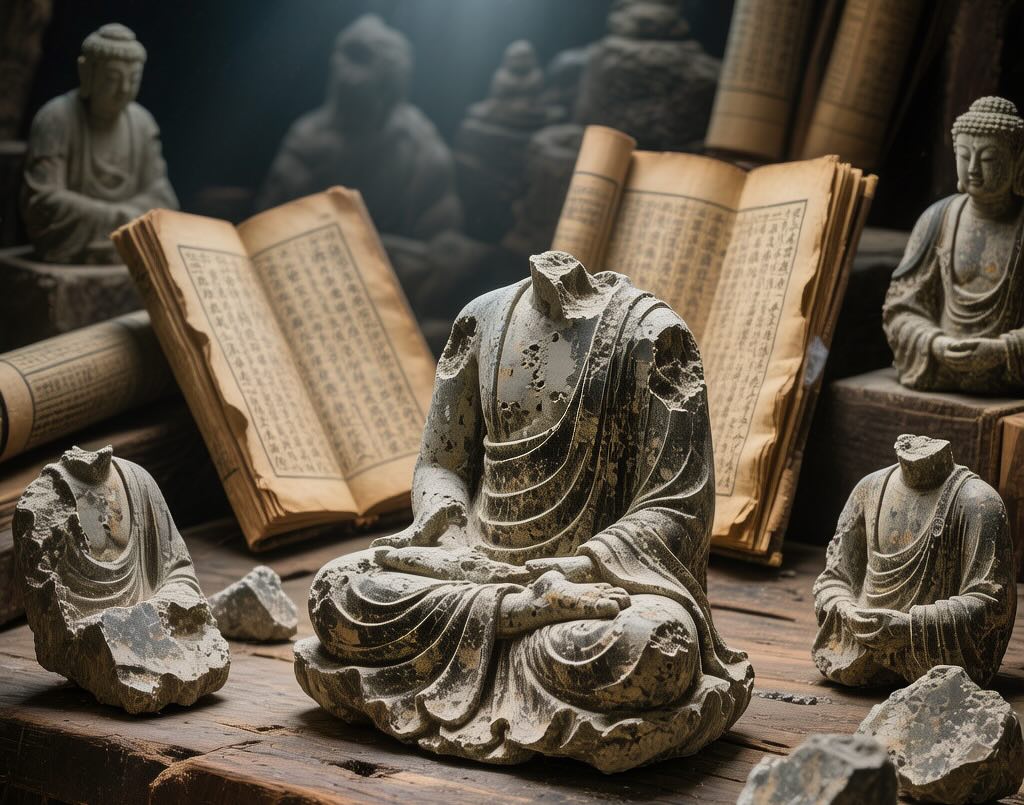
In an age dominated by materialism, there is a prevailing tendency to evaluate Buddhist icons and scriptures solely through the lens of artistic merit, market value, and craftsmanship, often overlooking their profound spiritual core. This is akin to the cache of sculptures unearthed at Qingzhou's Longxing Temple—mostly fragmented remains that were nonetheless ceremonially interred and preserved for centuries by the monastic community. Within the medieval Buddhist tradition, these icons were never conceptualized as "works of art." Instead, they served as sacred aids for meditative practice (guan-xiang), guiding practitioners toward a direct reflection of their true nature. This article aims to pierce through the external forms of Buddhist statues and sutras, exploring their authentic role as catalysts for awakening (bodhi).
The Icon as a Mirror to the Heart: Core Function and Purpose
Beyond Aesthetics: The Icon as a Medium for Contemplation
The primary function of a Buddhist icon has never been aesthetic appreciation. It is a spiritual medium grounded in the principle "to contemplate the icon is to contemplate the Buddha" (guanxiang ji guan fo). The practitioner first perceives the physical form with their eyes. Through contemplation and visualization, they open their "mind's eye," ultimately manifesting the true Buddha within their consciousness. In this process, the icon is merely a bridge—a guide for the spirit on its journey toward enlightenment. Consequently, the value of an icon lies not in its material, craftsmanship, or artistic style.
Form Follows Function: The Diversity of Iconographic Styles
Whether it's the Greco-Buddhist statues from Gandhara with their high noses and deep-set eyes, the "elegant bones and flowing robes" (xiu gu qing xiang, bao yi bo dai) sinicized style of the Northern Wei dynasty, the plump and graceful Tang dynasty figures with their "garments clinging like wet silk" (Cao yi chu shui), or even the uniquely Chinese icon of Water-Moon Guanyin (Shuiyue Guanyin)—seated in a relaxed posture gazing at the moon's reflection—each style serves as an expedient means (upaya) adapted to the cultural and spiritual capacities of its time and place. The Water-Moon Guanyin itself is a visual metaphor for the teaching of sunyata (emptiness), illustrating that all phenomena lack inherent existence. These diverse forms are but skillful methods; their core consistently points to the Buddha's wisdom (prajna), compassion (karuna), and the transcendent, genderless, and non-localized nature of enlightenment.
The Vajra (Diamond) Wisdom: Form Is Emptiness
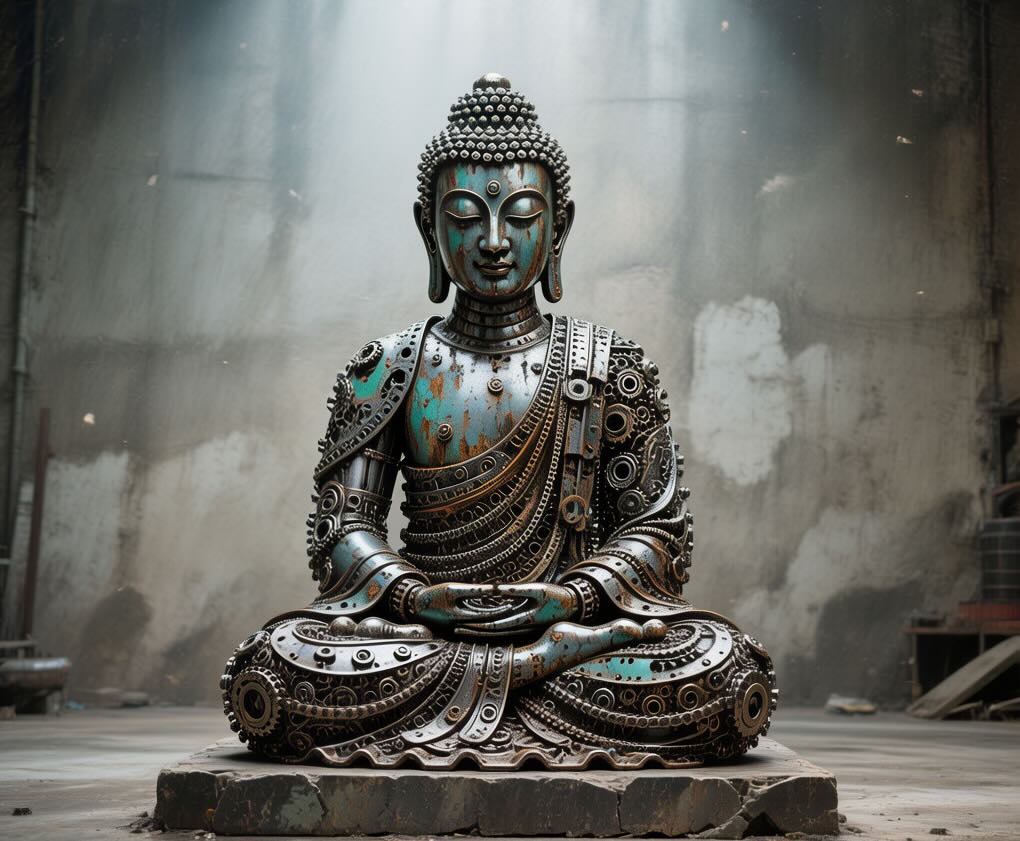
As stated in the Diamond Sutra (Vajracchedikā-prajñāpāramitā-sūtra), "All conditioned phenomena are like a dream, an illusion, a bubble, a shadow." This principle is vividly demonstrated by contemporary Kunming artist Li Huawen, who created 88 Buddha statues from recycled car parts, gears, and wheel hubs. Breaking free from the constraints of traditional clay or stone, he worked from the concept of "no self, no person, no being" (wu wo xiang, wu ren xiang, wu zhong sheng xiang). The ostensibly cold metal components convey the divine essence (shenyun) of the Buddha, proving that the icon's core is never its external form, but its ability to awaken the viewer's recollection of the Buddha's qualities (buddha-guna).
Sacredness in Fragmentation: The Longxing Temple Cache
The broken sculptures from Qingzhou's Longxing Temple further affirm this. During the anti-Buddhist persecutions of the Northern Zhou and Tang Wuzong eras, shattered icons were still venerated as embodiments of the Buddha. Their fragments, treated like sacred relics (śarīra), were carefully collected and buried together. For Buddhists, the sacredness of an icon does not depend on its physical integrity but resides in the spiritual essence it carries.
Cultural Adaptations, Unified Essence: The Spread of Buddhist Art
A survey of the history of Buddhist art reveals a continuous process of formal adaptation to local cultures.
- Initial Transmission to China: Early Buddhist icons were sometimes mixed with Taoist imagery and viewed as objects of immortal worship.
- The Sixteen Kingdoms Period: Statues retained strong Gandharan influences.
- The Northern Wei Dynasty: The royal commissions at the Yungang Grottoes exuded a majestic and solemn style.
- Eastern Wei & Northern Qi Dynasties: The Qingzhou region developed a distinct, elegant style with slender figures and thin, body-revealing robes.
- The Tang Dynasty: A trend toward secularization emerged, with Bodhisattva figures even adopting a sensuous, triple-flexed S-curve posture, integrating ideals of fullness and beauty from secular aesthetics.
The 33 forms of Guanyin in Chinese Buddhism, such as Water-Moon Guanyin, are entirely local creations. While not found in Indian Buddhist texts, they were developed by Chinese adherents synthesizing the teachings of the Lotus Sutra (Saddharmapuṇḍarīka-sūtra) with traditional painting aesthetics. The "moon in water" metaphor made it a perfect vehicle for conveying the wisdom of emptiness (sunyata).
These formal variations exemplify Buddhism's inclusivity: forms are merely "the finger pointing to the moon," while the core remains the ultimate truth of emptiness. As the Diamond Sutra teaches, "Whoever sees all signs as no-sign sees the Tathāgata." Attachment to an icon's material, age, style, or school is essentially attachment to form (lakṣaṇa). The Qing Dynasty monk-artist Liu Zhou created a "Hundred-Year Birthday Celebration" collage from over 30 fragmented antique ink rubbings. Though the inscriptions on broken bricks and tiles were incomplete, together they formed the auspicious character for "longevity" (shou), symbolizing the enduring vitality of cultural relics. This mirrors the Buddhist logic where icons retain their sanctity even in fragmentation: the form may break and evolve, but the inner spiritual kernel remains unchanged.
Buddhist Scriptures: The Vehicle, Not the Destination
Parallel to icons, the value of Buddhist scriptures (sutras) has never resided in their physical manifestation. Some disdain modest printed copies while idolizing gold-leaf manuscripts or ancient fragments—this is fundamentally a materialistic attachment. As the Platform Sutra (Liuzu Tanjing) states, "The wondrous principle of all Buddhas has nothing to do with words." Whether a scripture is worn or exquisite does not affect the liberating wisdom it carries.
From the Heart Sutra's (Prajñāpāramitā-hṛdaya-sūtra) revelation that "form is emptiness" (se ji shi kong) to the Buddha's enlightened teachings in the Lotus Sutra, each verse is a prescription for alleviating suffering and a practical map for spiritual cultivation (xiuxing), not an antique for appreciation or a mere philosophical text.
Today, many approach sutras as literary or philosophical works, seeking intellectual accumulation rather than practical application in their lives and practice. This diverges completely from their original intent. The Longxing Temple cache contained not only broken statues but also damaged scriptures. Like the icons, they were tools for guiding practice. Even if pages are torn and script faded, if a reader can translate its teachings into actionable guidance for their spiritual path, the scripture's purpose is fulfilled.
The Practitioner's Correct View: Transcending Form
Equality of Perception
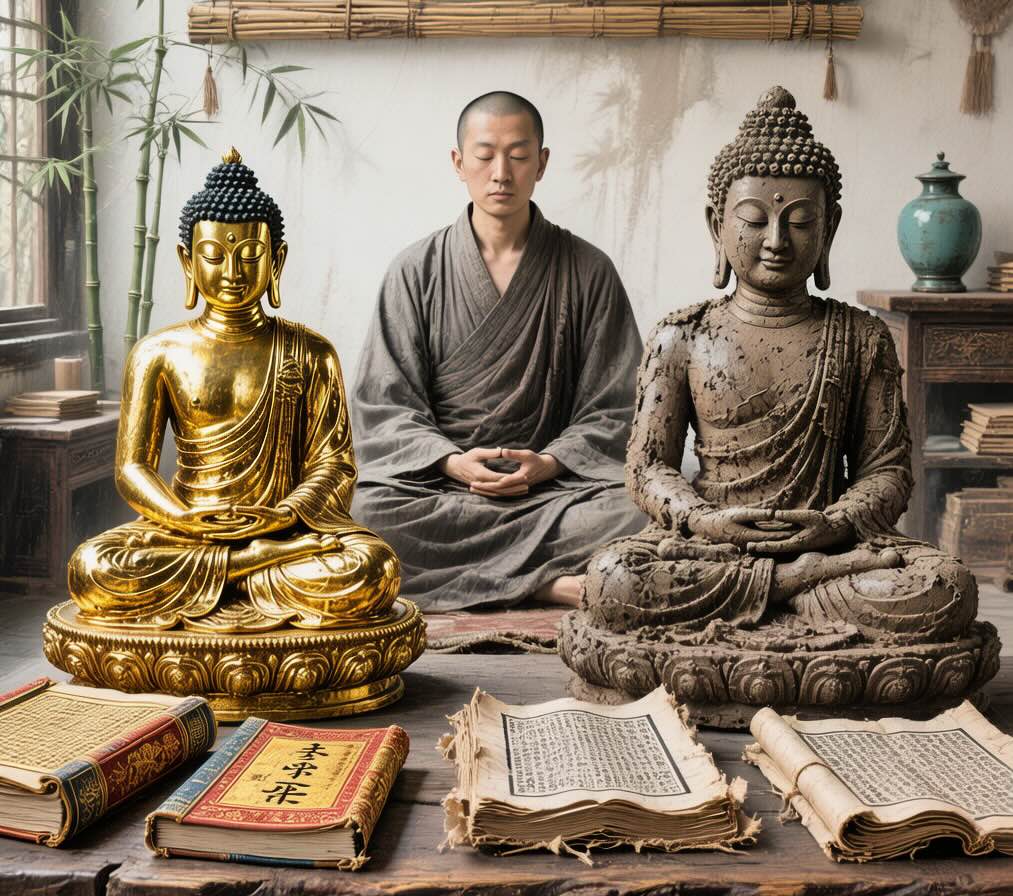
For practitioners, the first step is to transcend judgments based on material form. Whether an icon is gilded or molded from clay, whether a scripture is a gold-leaf manuscript or a humble printed copy—these distinctions are irrelevant to the essence of the practice. Burmese devotees create Buddha images from earth with profound piety. The fragmented scrolls from the Dunhuang Library Cave continue to inspire countless seekers. The key is to regard these objects with equanimity, focusing on the spiritual core they represent.
The Trap of "Spiritual Materialism"
One must be vigilant against the trap of "spiritual materialism": when collecting icons becomes a status symbol, when chanting sutras degenerates into mechanical repetition, or when acts of devotion (libai) inflate one's sense of superiority, one has already fallen into the error of attachment to form (zhi-xiang). The Śūraṅgama Sūtra (Lengyan Jing) warns: "Even across hundreds of thousands of kalpas, karma created does not perish. But without genuine cultivation, there will ultimately be no liberation." If one clings only to external forms, performing daily prostrations and recitations incessantly, true awakening remains elusive.
Integrating Symbolism into Daily Life
Authentic practice involves translating the symbolic meaning of icons and scriptures into everyday conduct. Seeing the serene smile of a Buddha statue should inspire compassion in one's interactions. Reading the wisdom of a sutra should translate into mindfulness (zhengnian), forbearance (renru), and loving-kindness in one's dealings with the world. The true offering (gongyang) is not merely incense, flowers, lamps, or fruit, but the daily practice of "diligently cultivating precepts, meditation, and wisdom, while extinguishing greed, hatred, and delusion."
Conclusion: Be a Lamp unto Yourself
Before his final Nirvana (parinirvana), the Buddha left this final instruction: "Be islands unto yourselves, be a lamp unto yourselves, with the Dharma as your island, the Dharma as your lamp." Buddha statues, sutras, and stupas are all fingers pointing to the moon. If we become overly fascinated with the beauty of the finger, we miss the moonlight itself.
In our materially affluent age, we must be especially wary of distorting these forms. Whether it's chasing exorbitantly priced icons, venerating ancient manuscripts as collectibles, or rigidly adhering to one "orthodox" artistic style—all such pursuits risk deviating from the true meaning of these symbols.
When we gaze upon an icon with a pure heart and read a sutra with a genuine thirst for the true Dharma (zhengfa), these objects cease to be cold artifacts. They become lamps illuminating the path to awakening. After all, true Buddha-nature (fo-xing) has never resided in external forms. It has always been within the heart of every being, awaiting the moment of awakening.


